Trade Less, Global book
LiveA 150-page trading-psychology book, published on five channels.
gear.efficientearners.comI run a company on a fleet of AI agents I designed. Before that I carried an enterprise sales quota for five years.
A computer science engineer who worked as a developer before my MBA, based in Bengaluru. Open to Delhi and relocation.
I started building on the side, with earlier AI tools, and shipped the first version of the market-data engine by hand.
I moved to agentic coding tools for everything: engineering, marketing and operations. I designed the agent fleet that still runs the company.
Payments went live on both platforms. The business stopped being a plan and became something people could actually buy from.
Each card names one real, measured number. Nothing below is invented.
 9,014-line pre-deploy gate
The paid member commerce platform: Cloudflare Pages Functions, KV and Durable Objects, Google OAuth and Razorpay. Signature check, idempotency, then corroboration against the provider before any entitlement opens.
The Desk sign-in screen, as far as any visitor without an account can go.
 ~60 defects fixed, one launch day
A second live storefront I built and deployed on my own: a PayPal checkout Worker, R2 signed delivery links and a KV ledger for the record. Earlier, a one-day launch audit for a family venture, Flippy Tales.
The My Little Lore storefront homepage, my own build.
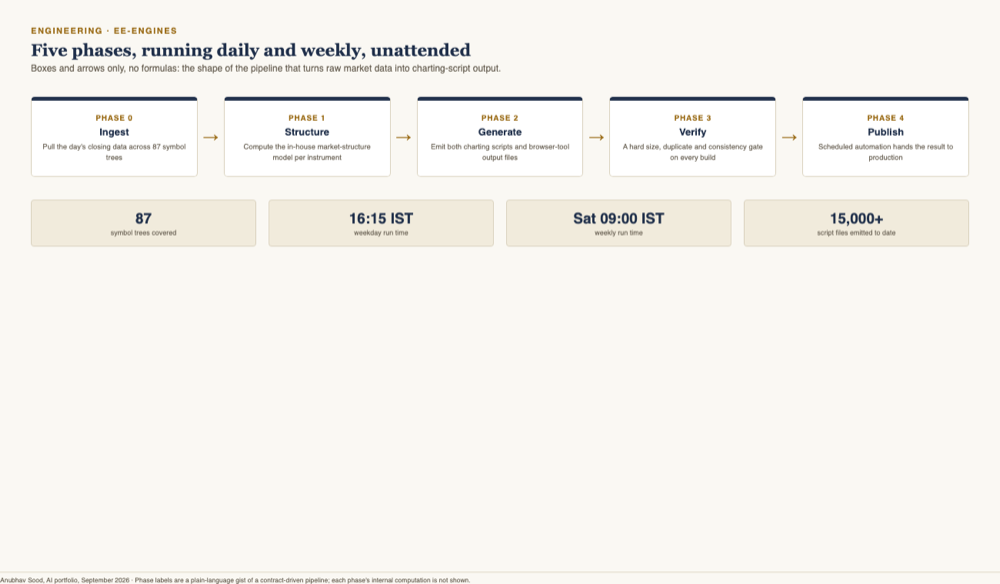 15,117 Pine Script files
An NSE data engine over 87 symbol trees, a five-phase contract-driven pipeline with sha-pinned computation, run daily and weekly.
The five-phase pipeline behind the market-data engine: ingest, structure, generate, verify, publish. Boxes and arrows only, no formulas.
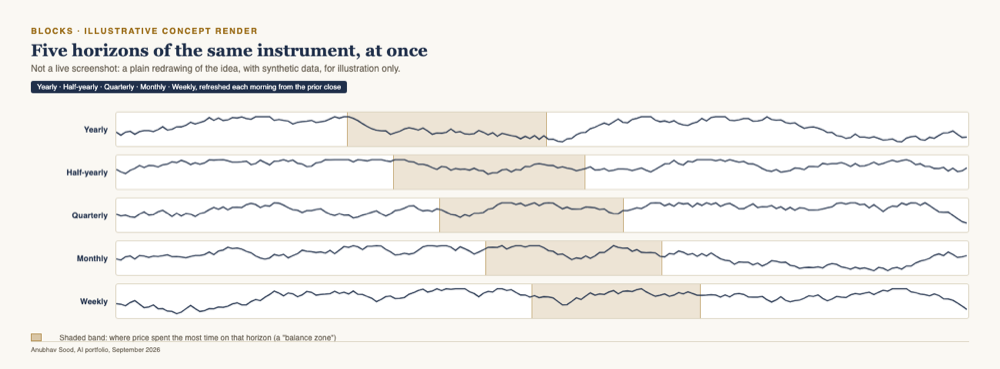 212 instruments, 17 sectors
A market-structure tool over 212 NSE instruments across 17 sectors, refreshed every morning. A fail-closed gate: if the check does not pass, nothing publishes.
Illustrative render of the core idea: the same instrument shown across five time horizons at once, each with its own shaded balance zone. Synthetic data.
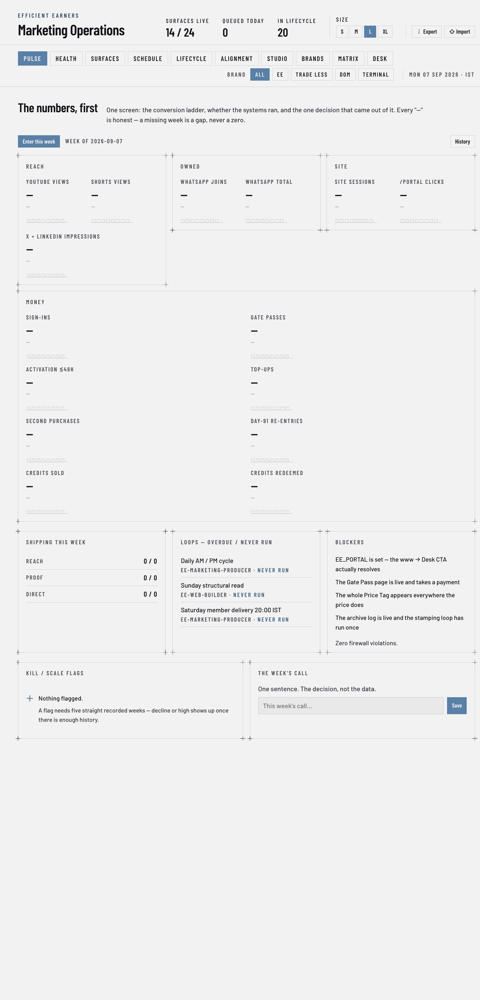 12 named agents
Twelve named agents under one front door, a judgment and mechanics split, a twelve-platform distribution map with UTM attribution.
The marketing operations dashboard, captured with placeholder figures, not live numbers.
 31 agents, two studios
Two multi-agent studios, one for shorts and one for long-form: script gates, scene maps, voice-over, subtitle burn-in, film QA before any render.
Title card from Module One of "The Read," the 72-chapter flagship video course.
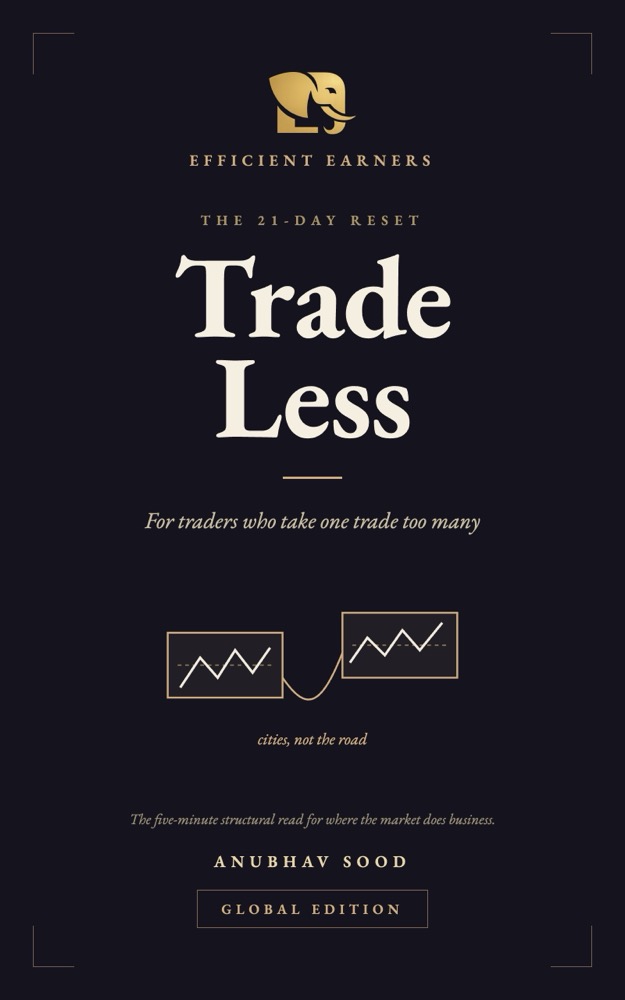 72 chapters, 3h16m
A 72-chapter video course built on a written teaching method, plus a 150-page book across five channels and an India edition.
Cover of "Trade Less," the Global edition.
A single self-contained app that reconciles founder hours and tracks AI-tool spend as a real, dated cost line, not background overhead.
A self-contained hour and spend reconciliation tool, shown here by its icon rather than a screenshot.
Every product and system from my own evidence inventory, in one grid. Completion figures are my own honest estimate, not an audited number, and I say so on every card.
A 150-page trading-psychology book, published on five channels.
gear.efficientearners.comA 152-page NIFTY and MCX localisation of the book, built but never listed for sale.
gear.efficientearners.comA roughly three-hour twenty-five-minute narration script plus a companion PDF. No narrator recorded yet.
The 72-chapter flagship video course behind the book. Built and QA-passed, no hosting decision made yet.
A 36-unit course on building small apps. All 36 scripts are written, none filmed.
A standalone trading-cost calculator app, published and selling.
An Etsy-style digital life planner, built and blocked on an OAuth issue with its listing images incomplete.
A free entry-level trading course. Blueprint only, scripts not started.
A line-by-line tax calculator, built and verified to the rupee. No price set yet.
A volume-profile companion course. One of 36 chapters finished.
A standalone costing tool, built twice as two working versions. No ship decision made.
A "pocket CFO" business-health app, built as version three. Not yet named or priced.
"The Read" course, sold as a one-time purchase inside the Desk platform.
desk.efficientearners.comThe India edition of Trade Less, sold as a one-time purchase inside the Desk.
desk.efficientearners.comBook and course bundled together, one flat price, no pro-rating.
desk.efficientearners.comThe F&O calculator, sold as a one-time purchase inside the Desk.
desk.efficientearners.comA four-module course teaching market structure by hand, never the engine math. Built, unsigned and not launched.
A five-horizon market-structure charting surface inside the Desk. The data engine runs live and automated daily. Membership payment is not switched on yet.
desk.efficientearners.comA 22-bundle printable wall-art storefront, live and taking real payments.
mylittlelore.comAn older listing on a different storefront, explicitly ruled out of scope by my own decision.
The NSE market-data and charting-script engine behind Blocks, automated daily and weekly, unattended.
The member commerce platform: Cloudflare Pages Functions, KV, Durable Objects, Google OAuth, Razorpay.
desk.efficientearners.comThe marketing and sales site for Efficient Earners.
efficientearners.comA retail and institutional charting terminal, paused for the current quarter with a defined re-launch checkpoint.
The research workbench for trading hypotheses, active and running pre-registered studies.
A self-built bookkeeping application, shipped and in active personal use.
The dashboard, protocol and agent fleet behind every marketing decision.
A portfolio of ten smaller ventures. One lane is active, nine are paused or blocked.
The storefront, checkout worker and delivery system behind My Little Lore.
mylittlelore.comAn earlier script-licensing factory, archived and superseded by a later decision.
Showing all 30 projects.
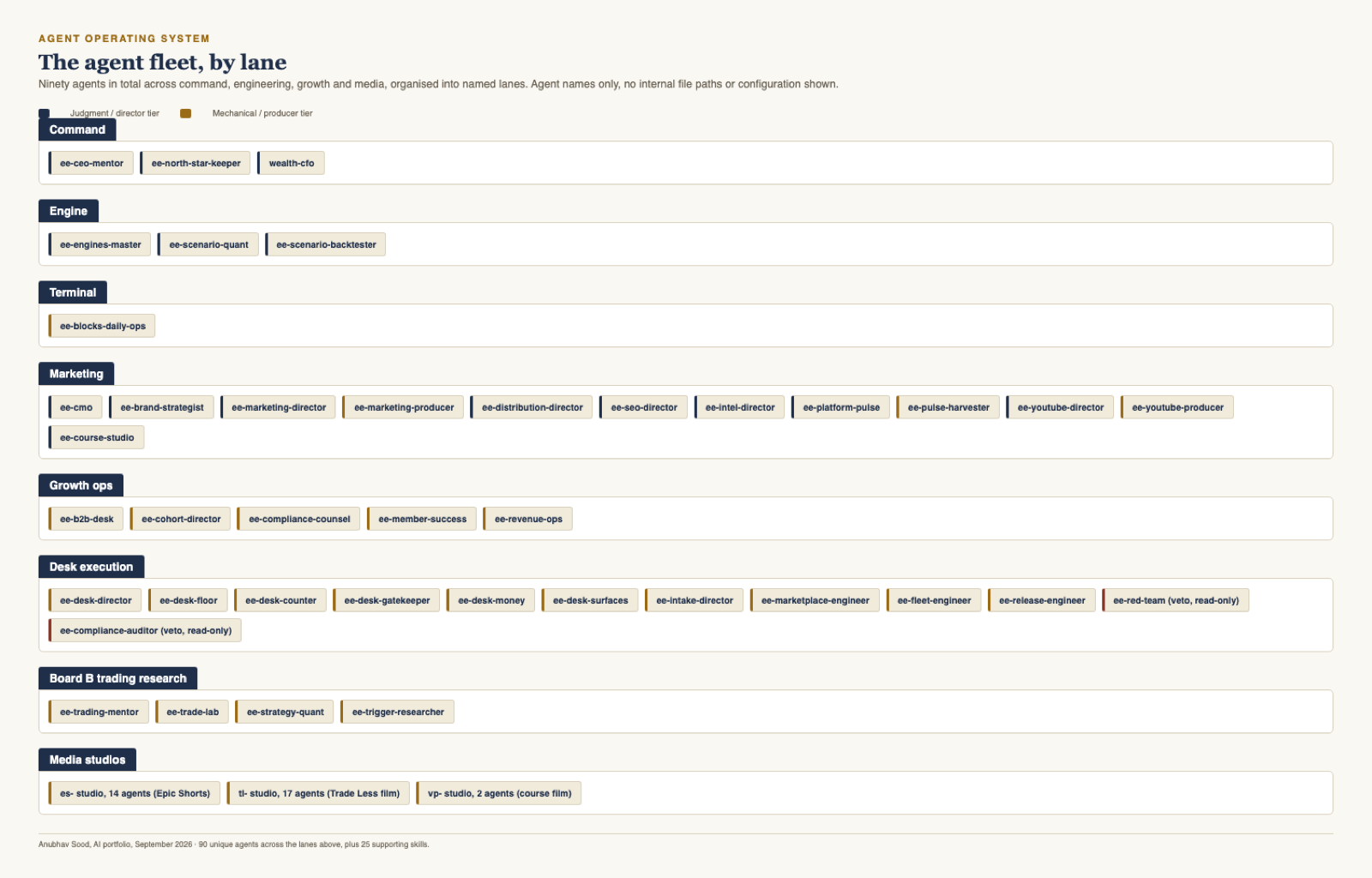
The ninety-agent fleet, grouped into its command, engineering, growth and media lanes, by name only.
| M1 | the fast tier handles file work by default. |
| M2 | the frontier-tier model fires only on eight named triggers, then hands back to the fast tier. |
| M3 | The frontier-tier model stays capped: a short packet, about fifteen verification reads, no exploration, no writes. |
| M4 | Never the smallest tier, not even for a simple search. |
| M5 | A risky task gets a second fast-tier pass or a read-only frontier-tier review, never a frontier-tier implementer. |
| M6 | Escalations carry a one-page findings map. The frontier tier never re-reads what the fast tier already read. |
3.6 million setups tested against 8 pre-registered cells. Zero of eight passed, and I kept that negative result rather than re-cutting the study.
A 9,014-line pre-deploy assertion script, plus live probes after every deploy with automatic rollback if something breaks.
A tool I wrote that prices every session against published per-token rates, so I see the real cost of the AI work, not just a usage bar.
Vocabulary and data-recency rules written as build-gate assertions, not a style guide. They rejected 7 of 7 draft captions in one real pass. The 30-day data floor I set later matched a July 2026 regulatory circular almost exactly: a cost accepted deliberately, not a margin I got for free.
I sell technical products the same way I build them: discovery first. I sit with the engineering or operations side of a deal before I talk price, so the business case I bring back is built on what the buyer's team actually needs, not on a generic deck.
That order, technical discovery then the business case, is why deals that were stuck on objections moved once I was in the room.
My traction is small today. The honest story is the operating system I built and the discipline behind it, not inflated numbers. Payments have been live since August 2026, and I say that plainly rather than dress it up.
This page is a portfolio of outputs, not construction. It shows what each system does or produces, not how the underlying engines compute their results. Where a system is still being built, I say so plainly, and the completion figures in section 03 are my own honest estimate, confirmed by nobody but me.
In progress, all due September 2026: a small application built on the LLM API with its own evaluation set, an MCP server, and a public reference architecture of the Desk platform.